
Insights from Juan Gallardo’s session at Italian Hospitality Investment Conference Milan, 2026
2026 has been an unusual year for European hospitality. Geopolitical instability in the Middle East has rerouted safe-haven demand toward Southern Europe, and Italy sits at the centre of that story.
The arrivals data backs it up. Tourist arrivals across Italy rose 4.43% in the first half of 2026 compared with the same period last year (Euronews). By summer, Italy had pulled clear of its usual rivals on volume: online booking platforms showed Italian accommodation running at 51.2% occupancy, ahead of Spain (42.8%) and France (32.9%), even with average nightly rates still below both. Banca d'Italia's balance-of-payments data confirms the same shift from the spending side — foreign traveller expenditure in Italy grew 4.8% year-on-year (YoY) in June 2026 alone, with the whole second quarter up 3.9% (Banca d'Italia).
So more visitors are arriving, and they're spending more once they get there. But the more interesting question isn't where the revenue is landing, it's what happens to it once it does. Our industry has always been better at tracking the top line than understanding what actually makes a hotel profitable.
Here's what the full P&L data, down to Gross Operating Profit (GOP), say about Italy's profit story this year.
Three chefs, three recipes: Germany, France and Italy
Before the Italian story, it's worth putting three major European markets side by side. Each has followed a very different recipe for profit over the last three years.
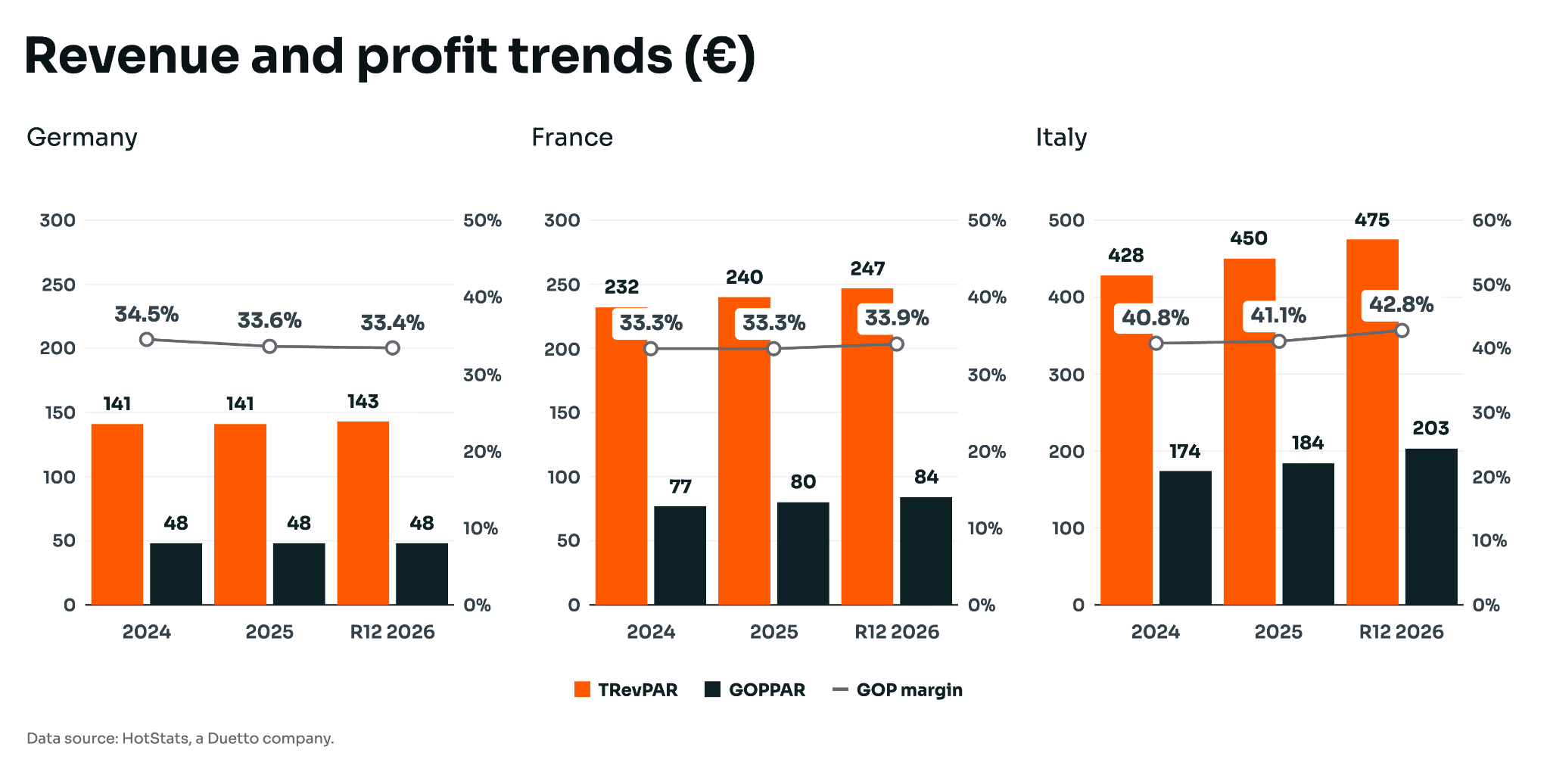
Germany's GOP margin has slipped from around 35% to 33%, as a flat domestic economy collides with minimum-wage increases. Costs are simply growing faster than revenue. France has been essentially flat.
Italy, though, has a different story: GOP margin has climbed from roughly 41% to 43%, lifted by the Jubilee wave, the build-up to the Winter Olympics, and the same demand shift already visible in this year's arrivals and spending figures.
So what's driving that growth?
Milan's sprezzatura moment
Start at the very top of the market, and the answer is already visible in one city.
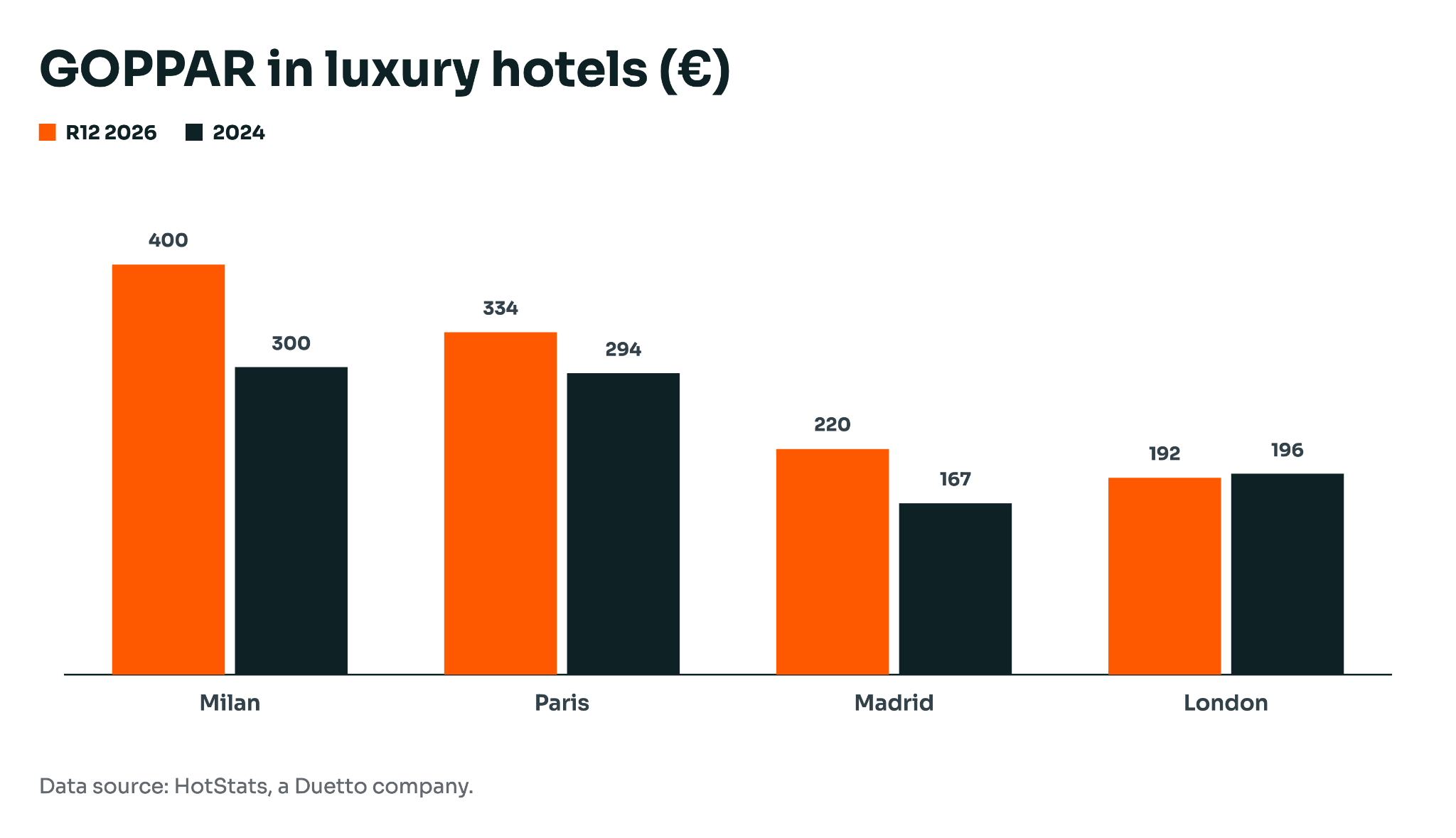
Among luxury destinations including Milan, London, Paris and Madrid, Milan's luxury segment holds the highest GOPPAR by a clear margin — up from roughly €300 to €400 (+33%) over the period. Paris follows at a similar pace of growth, Madrid trails both, and London is essentially flat to slightly down.
Milan's luxury hotels are riding two demand waves at once — Fashion Week and MICE business layered with Winter Olympics anticipation — and critically, it's ADR doing the work, not cost-cutting.
Call it sprezzatura for the balance sheet: looking effortlessly premium while demand, not cost discipline, does the heavy lifting.
Southern Europe's secret ingredient
Italy isn't growing in isolation, it's the standout performer in Europe's best-performing neighbourhood. With inflation and costs still elevated, most markets have already run their cost-control exercises, leaving the remaining lever as finding creative ways to grow revenue from every square metre.
Southern Europe's momentum reflects that same pull toward the region — strong leisure demand layered on top of this year's shift in travel patterns — and the GOPPAR gap between the region and the rest of the continent keeps widening. At the same time, growth has slowed across Europe over the last twelve months, suggesting we're seeing the tail end of the post-pandemic recovery, but Southern Europe is bucking that trend.
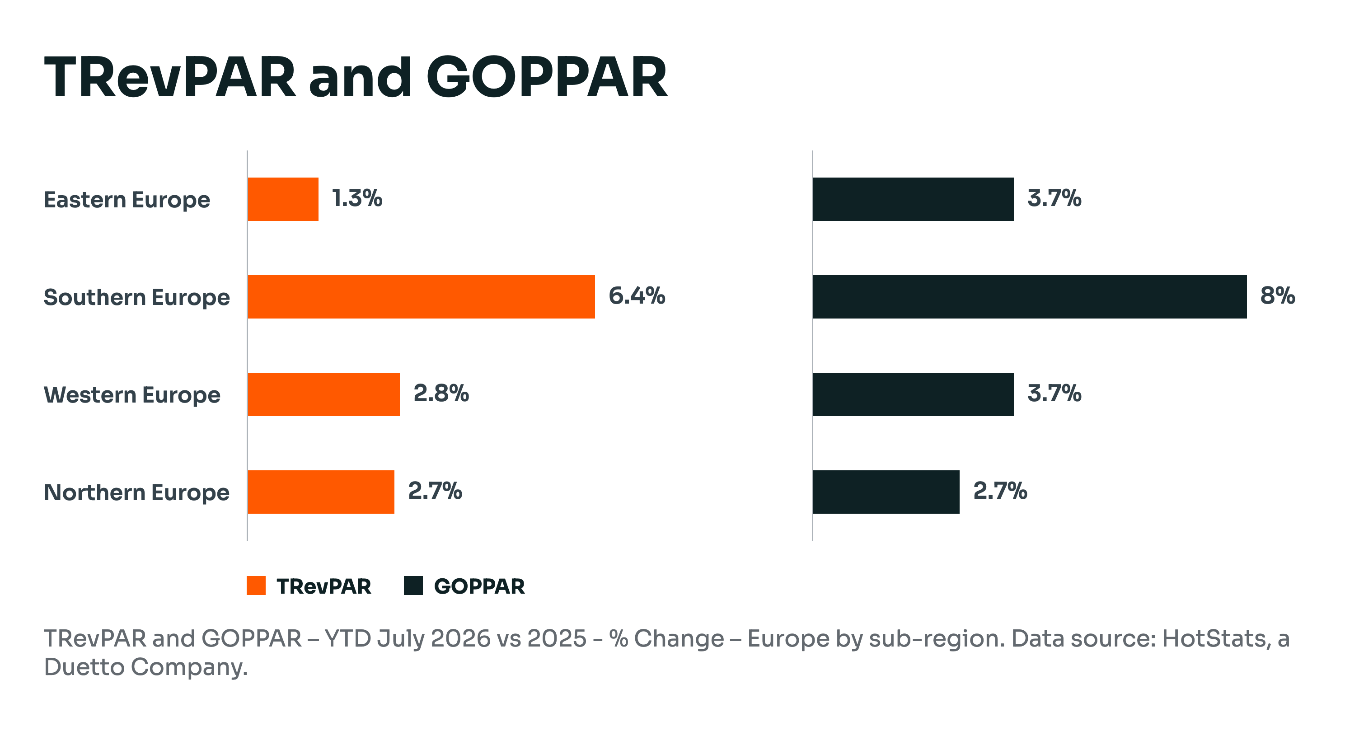
Year-to-date (YTD) to July 2026 versus 2025, Southern Europe's GOPPAR growth (+8.0%) is roughly double every other sub-region's, against TRevPAR growth of +6.4%. Two forces explain it: resilient leisure demand and this year's geopolitical rerouting. Eastern Europe is correcting after a strong 2025 comparable. Western Europe is holding steady. Northern Europe is the one to watch — revenue growth is thin, while labour costs keep climbing.
Where the margin gap keeps widening
Growth is one thing; whether it survives to the bottom line is another. On margin specifically, the regional picture sharpens further.
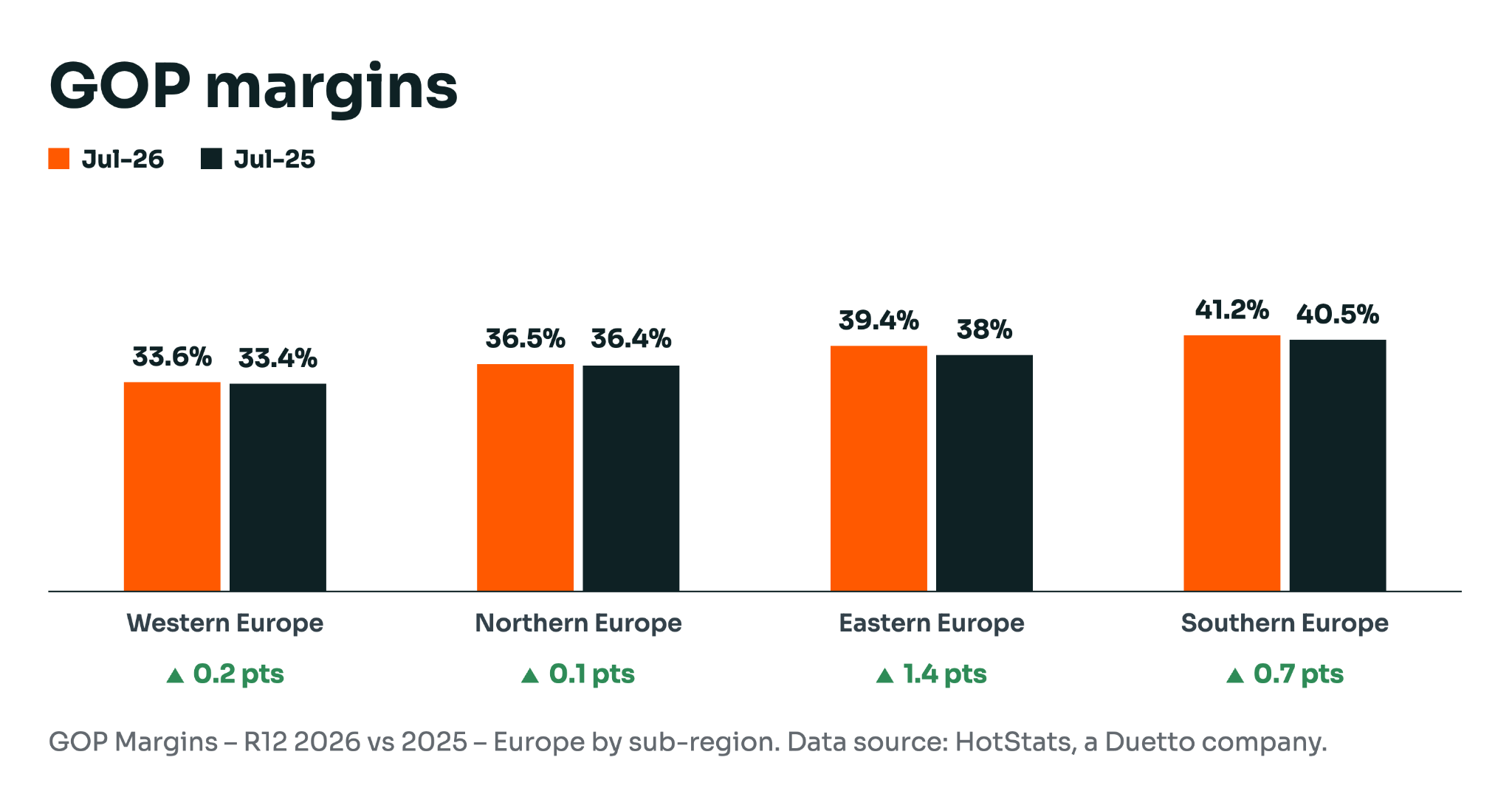
Southern Europe is the only sub-region running stable above 40% GOP margin (41.2% in R12 2026, up 0.7pt on the prior year). Eastern Europe posted the largest year-on-year improvement, up 1.4pt to 39.4%. Western Europe sits at the other end — the lowest GOP margin of the four, at 33.6%, up only 0.2pt.
Italy takes the head table
Zoom in from the region to the country, and the story sharpens further.
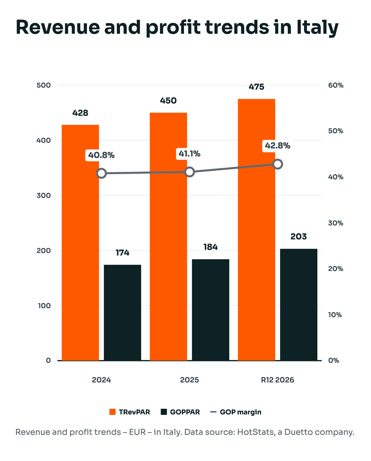
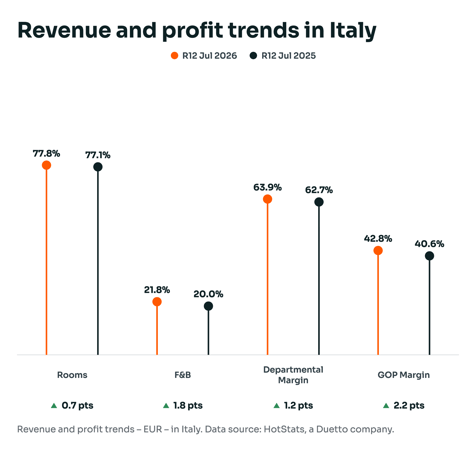
Italy didn't make it to the World Cup for a third consecutive tournament, but on GOP it's topping its own league.
Italy is one of the few European markets where TRevPAR, GOPPAR and GOP margin are all rising together, while most of the continent is flattening out. GOP margin hit a new high of 42.8% (+2.2pts year-on-year), on the back of ADR up 8%, occupancy up 1 point, and F&B revenue up 6%. Rooms margin reached 77.8% and F&B margin 21.8% — both comfortably ahead of the European averages of roughly 72% and 21% respectively — pulling departmental margin to 63.9% and GOP margin to a leading 42.8%.
Italy's quiet strength: the second course
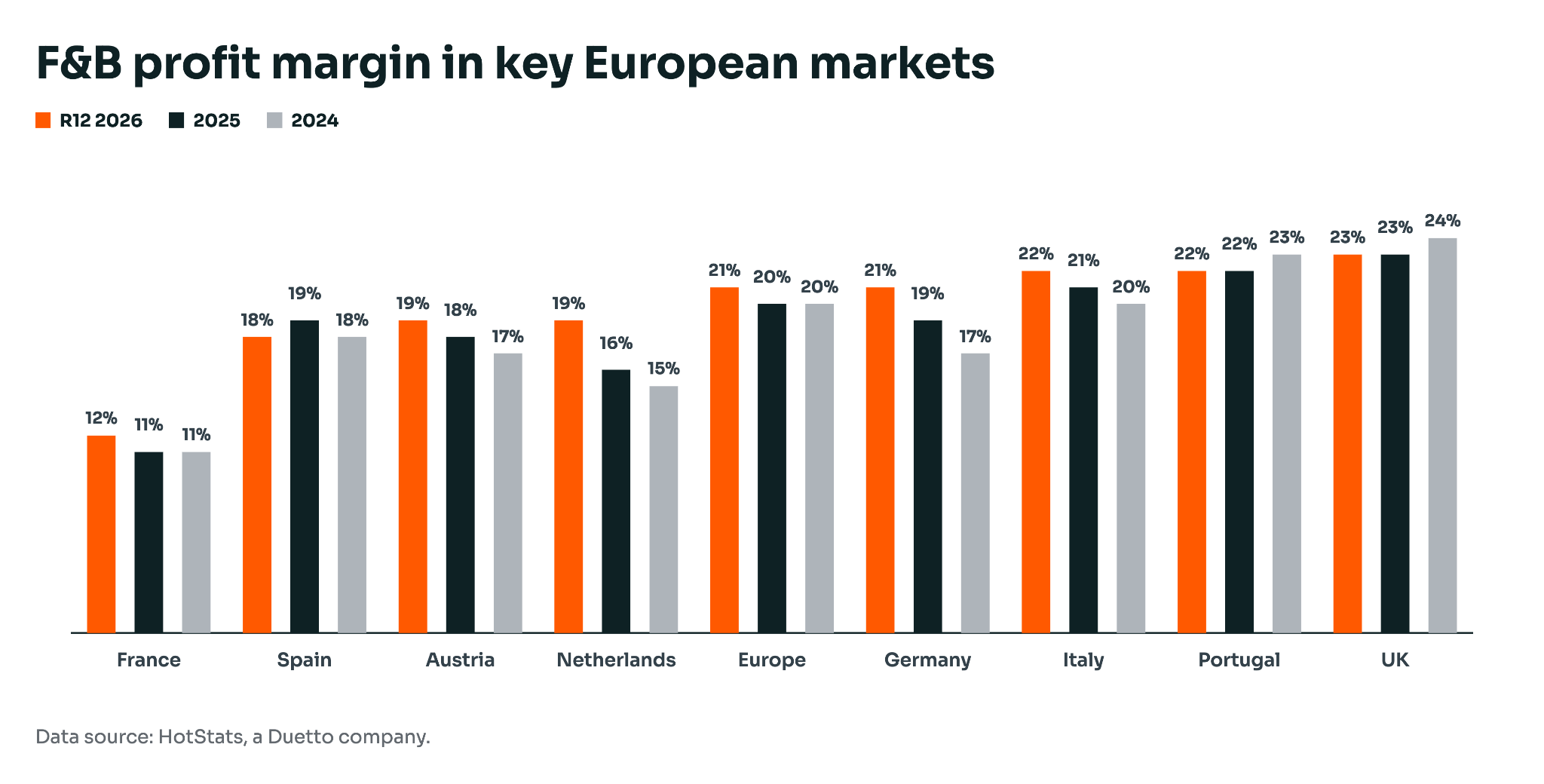
Italy's F&B profit margin (21.8% in R12 2026) sits above the European average and has now risen for three consecutive years — one of the stronger F&B recovery stories on the continent. Europe as a whole is still around 2 percentage points below 2019 levels, held back by slow revenue growth and rising labour and supply-chain costs, though the direction is encouraging: European F&B margins are up half a point YoY.
Break down where that Italian F&B growth is actually coming from and the picture sharpens further. Cover charges, function room rental, and banquet and conference revenue are doing the heavy lifting; traditional restaurant covers and in-room dining are lagging — in-room dining is actually down, as guests increasingly turn to delivery apps or eat out instead. The operating question this raises isn't "how do we drive more covers?", it's "how do we monetise events and space?"
That same "spend beyond the room" logic shows up in ancillary revenue. Wellness is performing well, with health club and spa revenue both up mid-single digits to double digits. Space rental is strong, and cancellation fees are up sharply (+24%) as hotels get stricter about enforcing their policies. F&B outlet revenue is more mixed, conference and banqueting revenue is growing faster than outlet covers.
How much pineapple can a pizza take?
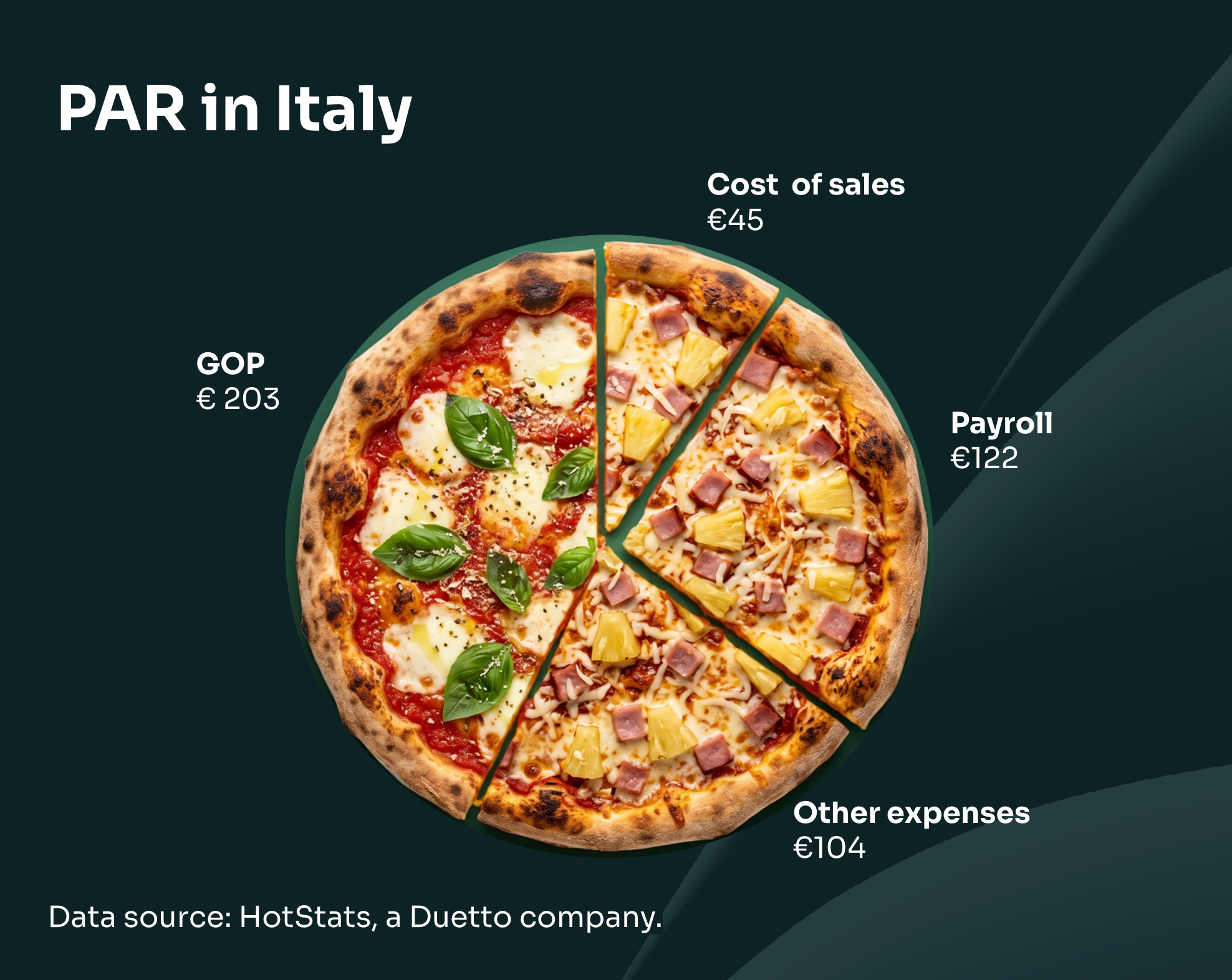
Think of Italy's €475 TRevPAR as a pizza.
GOP — the Margherita, the slice everyone actually wants — is the biggest piece at 43%, or roughly €203. Everything else is pineapple: cost of sales (around €45), payroll (around €122) and other expenses (around €104) are the topping nobody ordered, and it's creeping further onto the pie every quarter. Payroll is the biggest offender.
The real question for operators right now is how much pineapple you can put on a pizza before it ruins the whole thing.
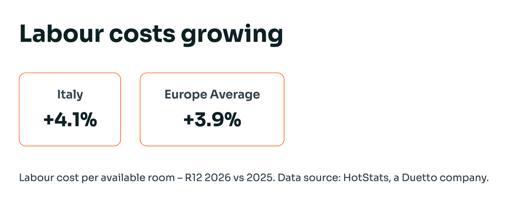
Labour cost per available room is up across every major European market, with Italy at +4.1% — above the European average of +3.9%.
Slicing Italy's own labour bill
Zooming into Italy's own kitchen, the same pressure shows up department by department.
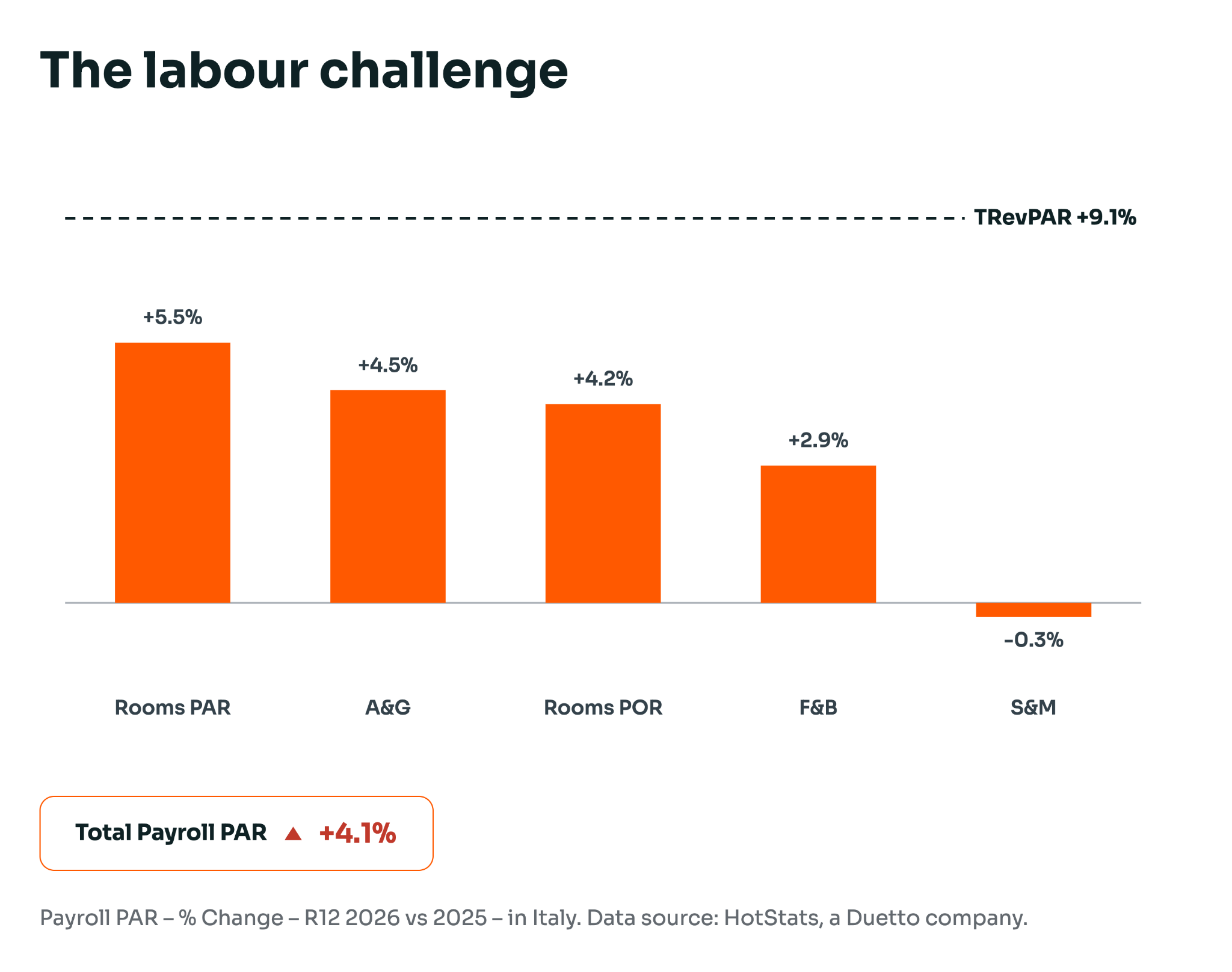
Breaking Italy's payroll growth down by department, rooms is the standout at +5.5%, ahead of A&G (+4.5%), rooms overhead (+4.2%) and F&B (+2.9%); sales and marketing payroll is actually down slightly (-0.3%). Total pay per available room is up 4.1% — comfortably below TRevPAR growth of 9.1%, which is what's protecting the margin. But that gap won't hold indefinitely.
One trend worth watching: a number of hotels have dropped daily stayover cleaning, partly to cut labour costs and partly in pursuit of sustainability goals. In-house housekeeping cost per occupied room is up only 1.5% and outsourced housekeeping up just 1% — both running well below wage growth, which only works if fewer rooms are actually being serviced.
It raises a fair question for owners and operators: can outsourced housekeeping agreements be renegotiated despite the wider wage pressure, given how much less volume is now being serviced?
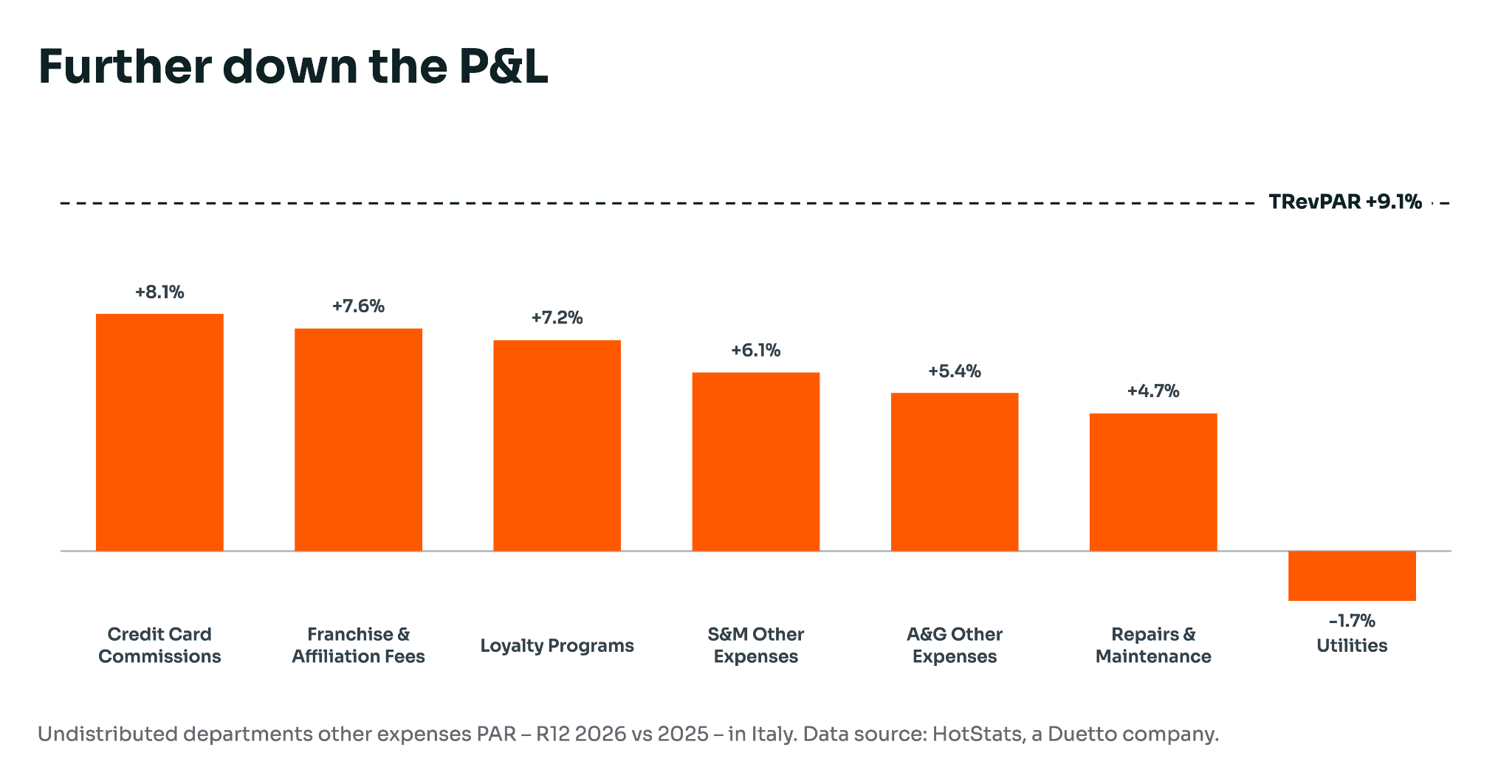
Further down the P&L, undistributed costs are a mixed bag. Credit card commissions (+8.1%) and franchise and affiliation fees (+7.6%) are both growing close to TRevPAR's pace — the former a function of guest payment behaviour, the latter likely reflecting more aggressive promotional activity to defend direct bookings against loyalty programme growth (+7.2%). The genuine bright spot is utilities, down 1.7% year-on-year, one of the few cost lines actually working in operators' favour right now.
The takeaway: Keep the base, change the toppings
Global revenue growth is slowing, but ancillary revenue is emerging as a real opportunity, both now and further out. Profit margins are flattening across most of Europe, and Italy is the clear exception, sitting at a new GOP margin high of 42.8%. F&B profitability has improved year-on-year as cost growth has eased. Labour remains the defining challenge across the continent, still running above inflation.
Guest payment behaviour continues to shift toward credit cards and loyalty programmes. And energy costs have fallen across Europe, quietly supporting margin growth for almost everyone.
Pineapple has already made one appearance in this piece as the cost line nobody wants. But it's worth a second look, because the same topping doubles as a question about opportunity. Stick with the Margherita — the same operating model, the same service and management tactics that have always worked — and you get a reliable, familiar result. Reach for the pineapple instead, and you're betting on AI and new technology to reshape how the business runs, even if it means breaking with tradition. Neither answer is wrong. But the operators worth watching are the ones treating this as a live choice rather than a default.
Keep your base and your secret sauce: the fundamentals of the business don't need reinventing. Just don't be afraid to change the toppings from time to time.